Categories
Recent Posts
What is Switchgear Maintenance?
June 2, 2020
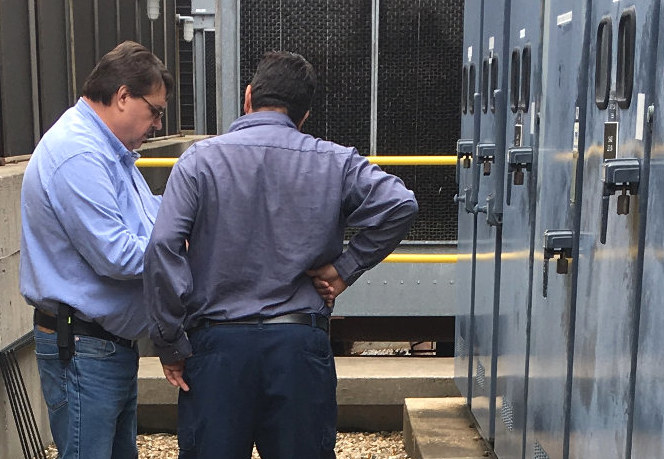
Preventive maintenance is the regular and routine maintenance of equipment that involves inspecting, servicing, and repairing machinery or systems to prevent breakdowns and ensure they continue to function efficiently. The goal of preventive maintenance is to identify and address potential issues before they develop into more serious problems that could cause equipment failure, downtime, or safety hazards.
Circuit breakers form the foundation of safety for any industrial electrical system as they protect both your equipment and your crew from harm caused by overloaded circuits, short circuits, and other electrical problems.
All protective systems should have a routine switchgear maintenance program in place to ensure everything is functioning as it should. Preventive maintenance will help you avoid costly breakdowns and industrial circuit breaker repairs.
Importance of Switchgear Maintenance for Circuit Breakers’ Efficiency
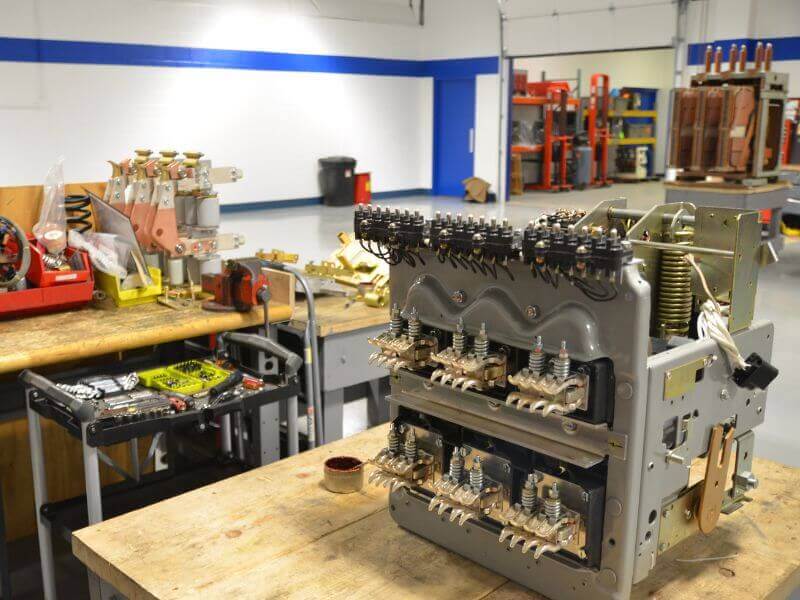
Preventive switchgear maintenance is typically scheduled and performed based on several factors to ensure equipment reliability, safety, and efficiency. The timing and frequency can vary depending on the type of equipment, its criticality to operations, environmental conditions, manufacturer recommendations, and historical performance data.
A facility that performs switchgear maintenance on schedule will typically experience fewer nuisance trips, lower operating temperatures, and more stable load handling. In contrast, poorly maintained breakers may experience contact resistance and sluggish operation, resulting in increased energy losses. These differences directly impact both equipment efficiency and overall operating costs.
If dirt and debris have accumulated inside the breakers, they may not operate correctly. Lubrication can break down over time, becoming sticky and gummy. This may also prevent the parts from moving freely and functioning as they should.
One of the greatest dangers of neglected switchgear maintenance is that industrial circuit breakers remain idle most of the time and are not in operation. Unlike the rest of your equipment, where a breakdown will be noticeable, you may not notice a problem with your breakers until one fails completely, leaving you with the option of halting production to perform industrial circuit breaker repairs.
Types of Circuit Breakers and Their Maintenance Needs
Regular switchgear maintenance and testing of your circuit breakers are critical, as planned production interruption will always be preferred over emergency industrial circuit breaker repair.
The specific schedule and routine for your breakers will depend on the type of breaker (i.e., molded-case, low-voltage, medium-voltage, and high-voltage) as well as the environment in which your systems are operating. For example, a clean production environment, such as electronics manufacturing, may require less frequent cleaning and maintenance than one that creates a substantial amount of dust and debris.
Testing is another important aspect of routine switchgear maintenance for your industrial circuit breakers, and this routine is also determined by the type of breakers you are using.
- Molded-case circuit breakers require minimal maintenance, but still need periodic attention. Preventive tasks often include a quick visual inspection, verifying trip functions under controlled conditions, and checking for terminal tightness. While generally reliable, environmental contaminants can shorten their service life if not addressed.
- Low-voltage breakers should be inspected every one to three years, depending on operating conditions. Typical low-voltage switchgear maintenance includes insulation resistance testing, infrared scans to detect hot spots, and mechanical operation checks to confirm smooth movement. Preventive care ensures protective functions activate correctly during faults.
- Medium-voltage breakers should be inspected annually. Common medium-voltage switchgear maintenance tasks include dielectric testing of insulation, contact resistance measurements, and functional testing of protective relays. Because these breakers often serve critical loads, medium-voltage circuit breaker maintenance is essential to avoid production-wide outages.
- High-voltage circuit breakers need the most frequent switchgear maintenance, with a maximum of six months to one year between checks. Maintenance includes comprehensive cleaning, lubrication of moving parts, and advanced testing such as timing analysis and gas pressure checks (for SF6 units). Regular service prevents catastrophic failures and ensures compliance with reliability standards.
How Switchgear Maintenance and Circuit Breaker Testing Work Together
Switchgear maintenance and testing are a core part of preventive maintenance, verifying that protective functions work as designed. Routine testing is generally a simple procedure that can be done onsite and without halting operations in most cases. NETA-certified acceptance testing ensures your devices are working according to the most recent NETA specifications.
Key components should be inspected, including arc chutes, contacts, and connections. Contact resistance testing should be performed to verify proper resistance values and other relevant parameters. For low-voltage breakers, primary and secondary injection testing is also completed to verify fault trip and overload protection.
The exact type and frequency of testing depend on your operations, but these are some standard testing procedures that may be performed to avoid disruptive industrial circuit breaker repairs:
- Circuit Breaker Analyzer. This device tests the timing of the breaker’s open and close operations, as well as the synchronism of the poles during different operations.
- Micro-ohmmeter. Resistance tests, such as those performed with a micro-ohmmeter, are necessary to prevent hot spots within the breaker and detect potential problems before they occur.
- Infrared Inspections. Infrared inspections are useful for identifying hot spots that can be caused by defective connections and components. When an increase in resistance causes excessive heat, components may fail. Early heat detection can prevent failures.
How Circuit Breaker Preventive Maintenance Improves Efficiency
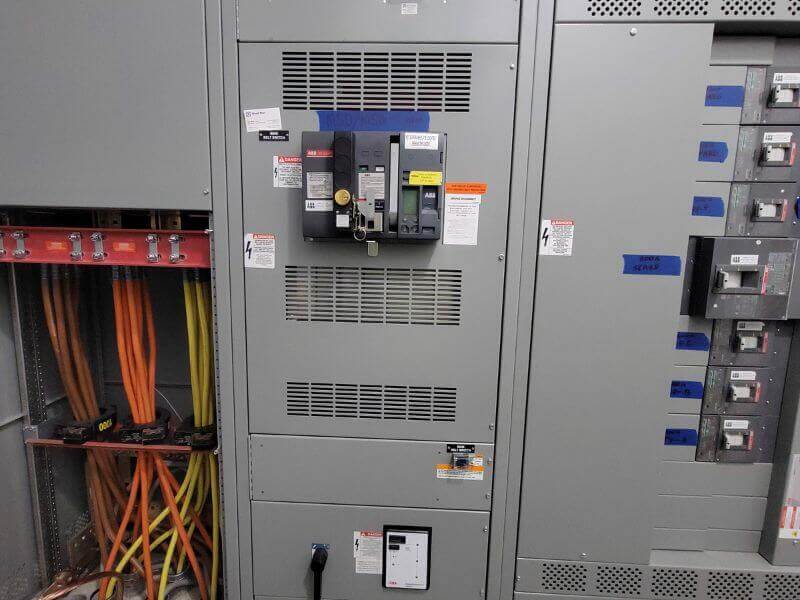
Some breaker types, such as molded-case circuit breakers, require very little maintenance. Other breaker types should be part of a regular electrical switchgear preventive maintenance schedule that is frequent enough for your equipment and environment.
Some common maintenance procedures may include:
- Cleaning. Dirt and debris inside the breaker can cause several problems, from failure to trip to fluctuations in the power supply. Cleaning involves removing the cover from the breaker, performing a visual inspection, and cleaning using vacuum tools or swabs and isopropyl alcohol.
- Lubrication. Lubrication prevents metal-on-metal wear, which can slow down mechanisms and increase operating resistance. Lack of lubrication or deterioration of the lubricant is one of the leading causes of breaker failure, leading to industrial circuit breaker repair. Primary and auxiliary connections, pivot points, main contacts, and operating mechanisms should all be checked for proper lubrication.
- Tightening & Retorquing. Proper torque maintains tight and stable current paths. The NEC added proper tightening torque to the list of requirements for electrical connections in 2017, and this includes circuit breakers. The manufacturer of the breaker will have a recommended value printed on the breaker or listed in their literature, and these values should be verified periodically.
These switchgear maintenance practices reduce heat buildup, improve current flow, and keep systems operating at peak efficiency.
Preventive Maintenance for Medium-Voltage Switchgear Systems
Medium-voltage switchgear is central to power distribution and requires more frequent attention than low-voltage equipment. Because these systems carry higher loads, even small issues can lead to serious faults or extended outages.
Preventive switchgear maintenance focuses on cleaning insulating surfaces, verifying relay calibration, and performing dielectric and contact resistance tests to ensure optimal performance. Thermographic inspections also help identify loose connections or failing components before they cause downtime.
Since medium-voltage gear is often installed in demanding environments, such as substations or heavy manufacturing facilities, these conditions can accelerate wear. A structured preventive maintenance of switchgear program ensures reliability, extends service life, and meets compliance standards.
Quad Plus delivers NETA-certified testing and medium-voltage switchgear maintenance to keep systems safe and dependable.
The Role of Electrical Switchgear Maintenance in Safety
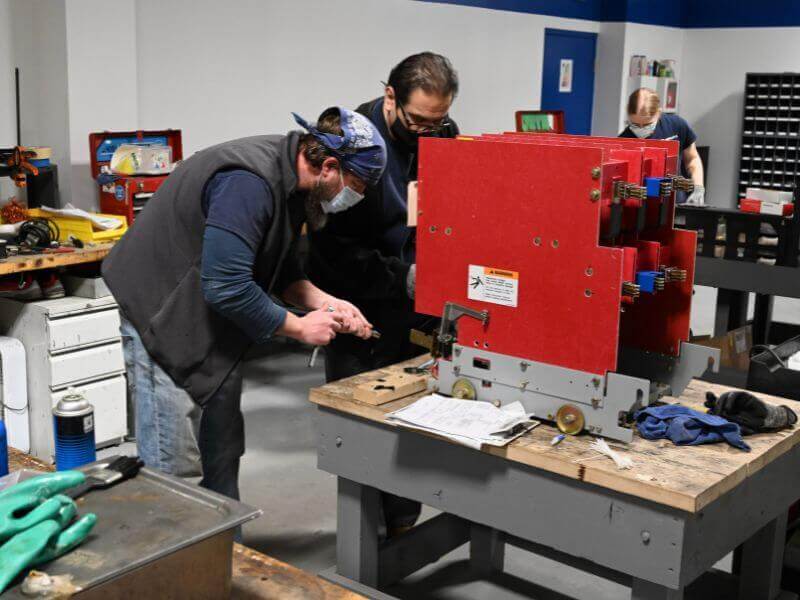
Electrical switchgear maintenance is essential for protecting workers and equipment. Arc flash prevention is one of the clearest safety benefits of routine maintenance. By keeping connections tight and insulation intact, the likelihood of a dangerous fault is greatly reduced. Well-maintained switchgear also lowers secondary risks, such as triggering fire suppression systems or forcing emergency shutdowns.
If contacts, mechanisms, or insulation degrade, breakers may not trip during faults, increasing the risk of fires or arc flash incidents. Circuit breaker preventive maintenance, which includes torque checks, lubrication, and relay testing, ensures that switchgear responds correctly to overloads and short circuits. Compliance with OSHA, NFPA 70E, and NEC standards also depends on maintaining equipment in a safe, documented condition.
Properly serviced switchgear reduces hazards for maintenance staff and safeguards production assets. We emphasize safety in every inspection, helping facilities lower risk and maintain reliable, code-compliant systems.
Maximizing Equipment Life with Switchgear Preventive Maintenance
Beyond efficiency and safety, electrical switchgear preventive maintenance maximizes the life of switchgear and circuit breakers. Routine maintenance and testing are far easier to work into your production schedule than unexpected downtime.
Additional benefits of preventive maintenance include:
- Enhanced Safety. Regular switchgear maintenance ensures that automation equipment operates safely and reliably. Malfunctioning automation systems can pose safety risks to workers and the production environment. Preventive maintenance helps mitigate these risks by keeping equipment in optimal condition.
- Extended Equipment Lifespan. By addressing wear and tear through switchgear maintenance, the lifespan of equipment and systems can be extended. This maximizes the return on investment (ROI) for expensive automation assets.
- Optimized Performance. Well-maintained systems operate more efficiently and effectively. Preventive maintenance activities, such as cleaning, calibration, and software updates, help optimize performance, resulting in improved productivity and higher quality of output.
- Cost Savings. Although preventive maintenance requires upfront investment in time and resources, it ultimately reduces overall maintenance costs in the long run. It helps avoid costly emergency repairs, production losses due to downtime, and premature replacement of equipment.
With consistent preventive switchgear maintenance, circuit breakers designed for a 20-year service life can often remain reliable for 30 years or more. Detailed record-keeping during maintenance also supports predictive strategies, allowing facility managers to spot trends and extend the useful life of equipment with targeted interventions.
What is an Example of Preventive Maintenance?
An example of preventive maintenance for industrial circuit breakers includes a combination of visual inspections, functional testing, and cleaning. Here’s a breakdown of the steps involved:
- Visual Inspection:
- Check for physical damage and signs of overheating.
- Functional Testing:
- Test operation under load conditions.
- Verify trip settings and conduct insulation resistance tests.
- Cleaning and Lubrication:
- Remove dust and debris from components,
- Clean and lubricate moving parts as needed.
- Tightening and Torque Checks:
- Ensure terminal connections are tight and torqued correctly.
- Record Keeping:
- Maintain detailed records of maintenance activities.
- Schedule next maintenance based on findings.
By regularly performing these tasks, you can ensure the reliability and safety of your industrial circuit breakers.
Choosing the Right Professionals for Circuit Breaker Maintenance
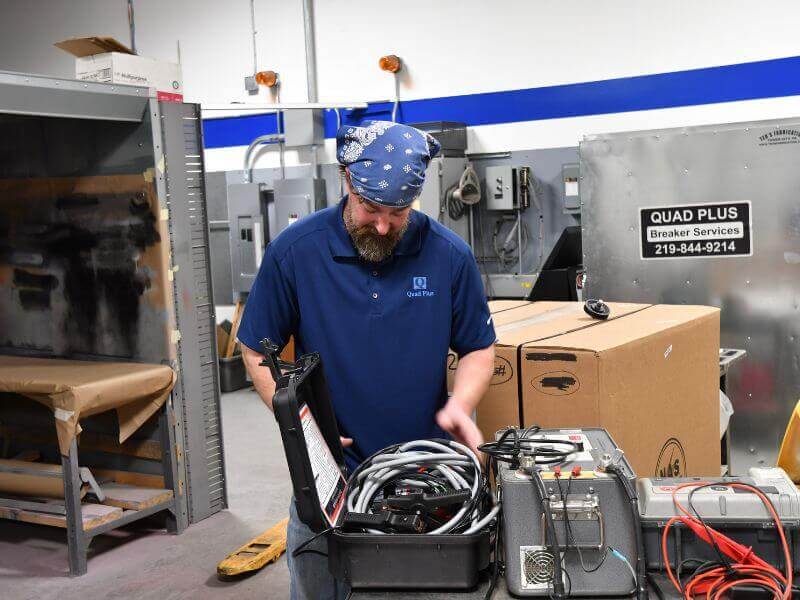
Preventive maintenance plays a crucial role by increasing reliability, reducing downtime, improving safety, and optimizing performance. By implementing a switchgear maintenance and testing program, you can save costs associated with emergency repairs and unplanned downtime, while also improving the reliability and longevity of your equipment and system assets.
If you’re not sure how frequently to test and inspect your electrical equipment or what type of routine maintenance is necessary, Quad Plus can help. We’ll work with your team to develop a schedule and routine for preventive maintenance of switchgear that helps avoid unexpected industrial circuit breaker repair and reduces the incidence of costly downtime.
Contact a Circuit Breaker Expert today for more information and support.
Frequently Asked Questions
Key components include circuit breakers, busbars, protective relays, insulators, arc chutes, and connections. Preventive maintenance tasks include cleaning, lubrication, contact resistance testing, torque checks, and verifying protective trip functions to ensure electrical switchgear operates safely and efficiently.
Neglecting switchgear maintenance can lead to insulation breakdown, overheating, stuck mechanisms, and failed tripping during faults. This increases the risk of equipment damage, unplanned downtime, and safety hazards to personnel. In many cases, neglected systems face costly emergency repairs or premature replacement.
Yes. Circuit breaker preventive maintenance addresses wear, contamination, and lubrication breakdown before they cause failures. Regular inspection and servicing optimize performance, reduce stress on components, and extend the useful life of circuit breakers.
Industries with high electrical loads or continuous operations, such as manufacturing, energy, data centers, healthcare, and transportation, benefit the most from this approach. Preventive maintenance of switchgear ensures reliability, minimizes costly outages, and supports compliance with safety standards in these critical sectors.